

Tai Kwun – From Law and Order to Art and Culture
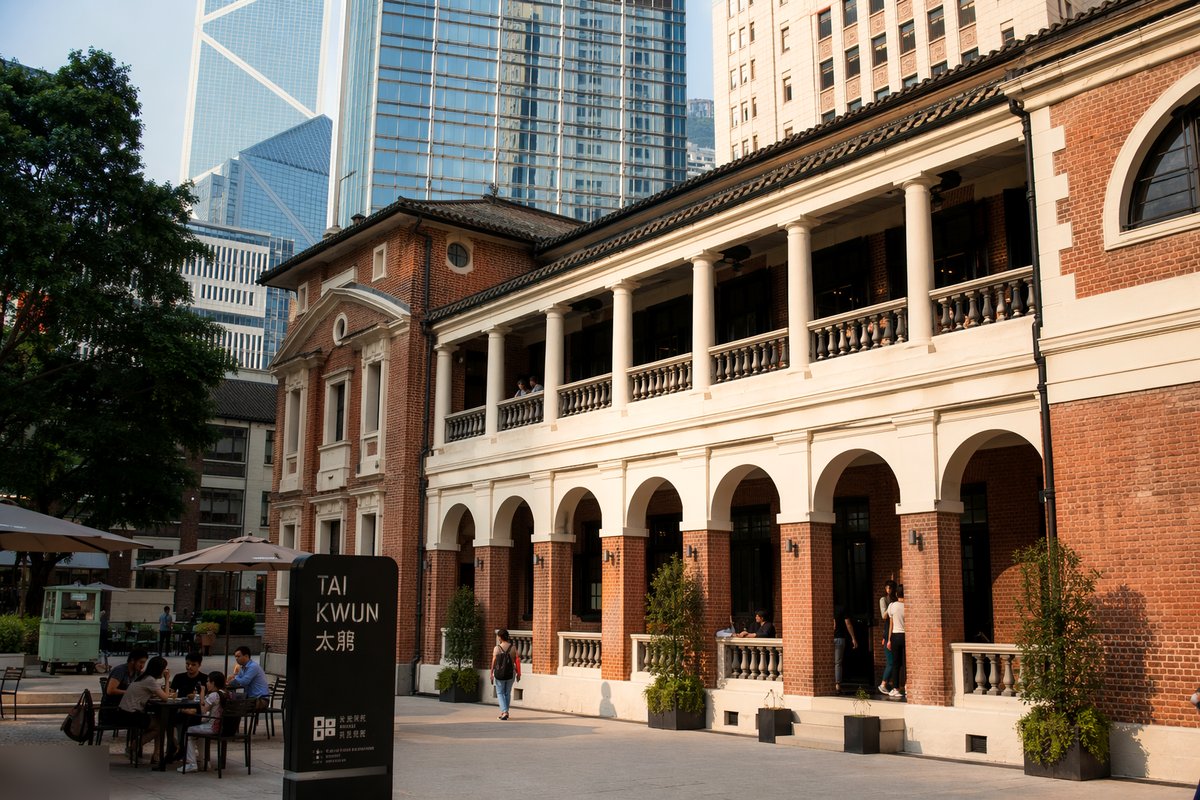
In the middle of Central Hong Kong, surrounded by glass towers, stands a walled compound of granite and red brick where the city once dispensed justice — and now dispenses art. This is Tai Kwun, the former Central Police Station, reborn as Hong Kong's most fascinating cultural hub. For me as a guide, it's the perfect stop: one address that tells the whole story of this city.
The "Big Station" of Colonial Hong Kong
Locals simply called it Tai Kwun — "Big Station" in Cantonese. Its roots reach back to 1841, when Captain William Caine, Hong Kong's first Chief Magistrate, built the city's earliest magistracy and prison here. By 1864, the compound had grown into a triad of colonial authority: the Central Magistracy, Victoria Prison and the Police Headquarters. The architecture still makes the point — Doric columns, Roman arches, and the engraved letters "G.R." for Georgius Rex, King George V. This was design as a statement of power.
Victoria Prison: 140 Years Behind Bars
For over 140 years, Victoria Prison held inmates — making it one of the longest-serving prisons in the region before closing in 2006. The cells are soberingly small: when full, three prisoners shared a single room. Over time, the philosophy shifted from punishment to rehabilitation, with vocational courses preparing inmates for life after release. And in the 1980s, the site took on an unexpected role as a processing centre for Vietnamese boat people. In the holding cell beneath the court, you can still see original Vietnamese graffiti etched into the walls — a haunting, human reminder that my guests never forget.
From Monument to HK$3.7 Billion Revival
Declared a monument in 1995, the compound was transformed by the Hong Kong Jockey Club with star architects Herzog & de Meuron. After a decade of restoration and HK$3.7 billion, Tai Kwun reopened in 2018 — no longer a place of confinement, but of creativity. Two striking new buildings complete the dialogue between eras: JC Contemporary, a gallery hosting 5–8 exhibitions a year, and JC Cube, an auditorium for performances with the open-air Laundry Steps beneath.
Prison Cells, Fine Dining and a Dragonfly Bar
What I love most: you can dine inside history. The Magistracy serves fine dining in a former courtroom, every detail breathing its judicial past. And Dragonfly — a bar in full art nouveau style, Tiffany lamps covering the ceiling — is, in my honest opinion, one of the coolest rooms in Hong Kong. Between exhibitions, browse the excellent teashop or simply wander the parade ground where police once drilled.
· Entry to the compound and heritage exhibitions is free — one of the best-value sights in the city.
· Come late afternoon: explore the cells, then watch the buildings light up at dusk from the parade ground.
· Combine with Man Mo Temple and the Central–Mid-Levels escalator — all within a 10-minute walk.
· Check the exhibition calendar online — JC Contemporary's shows are often world-class.
A Dialogue Between Eras
Tai Kwun shows what Hong Kong does best: honouring its past while reinventing it. Where control once ruled, openness now invites you in — history meets art, prison walls meet poetry. Come wander it with me, and I'll show you the details most visitors walk straight past.